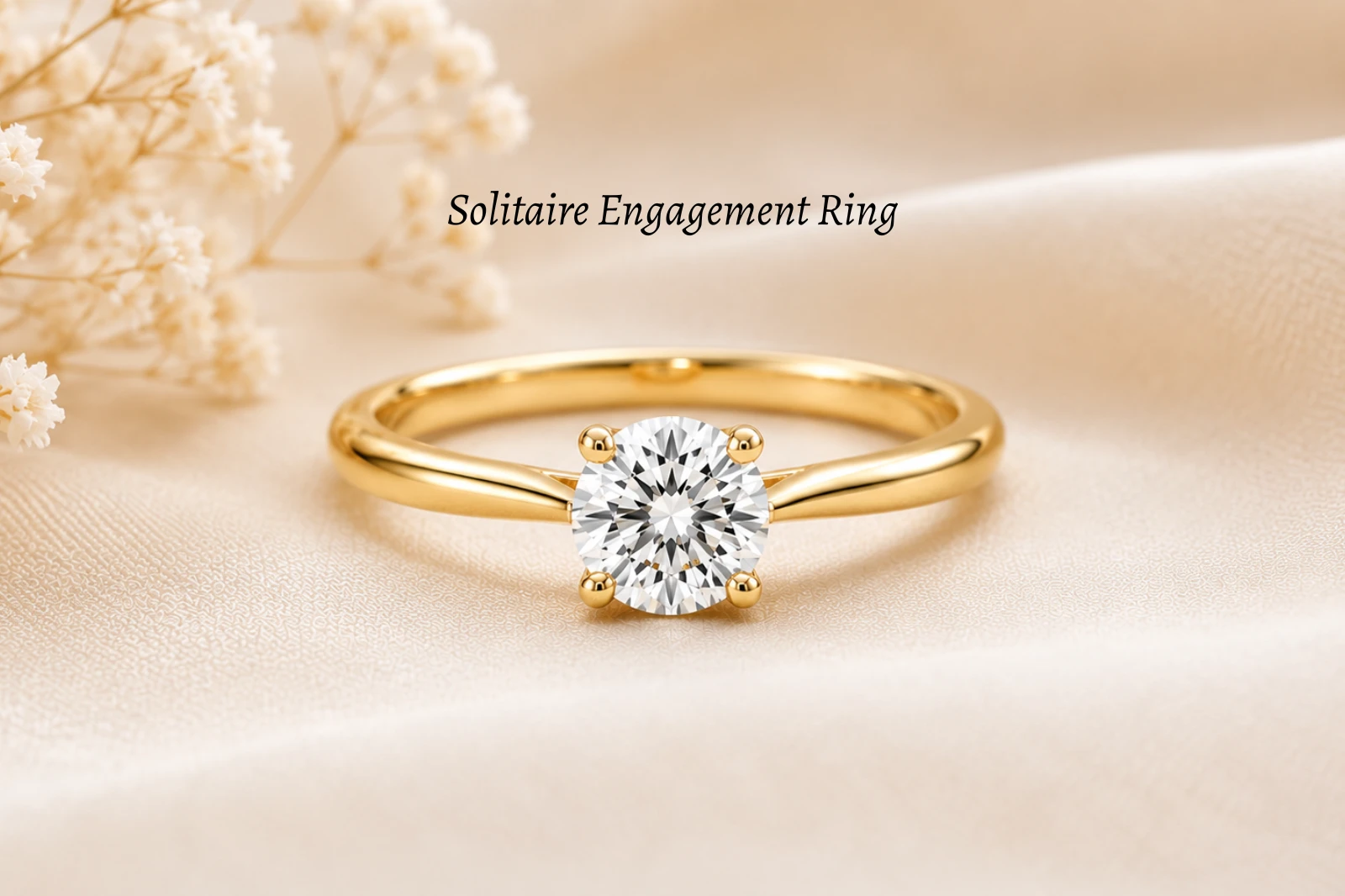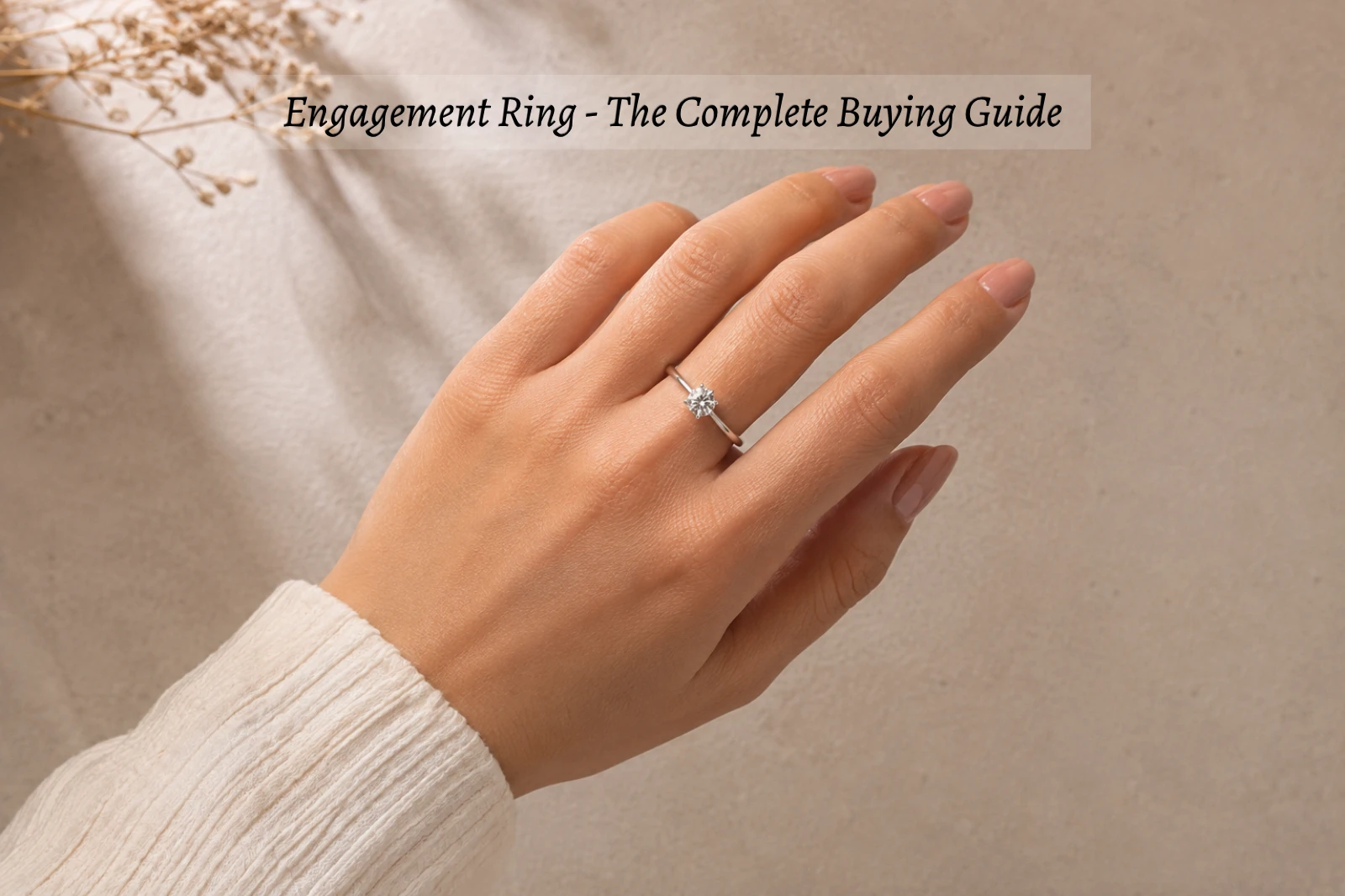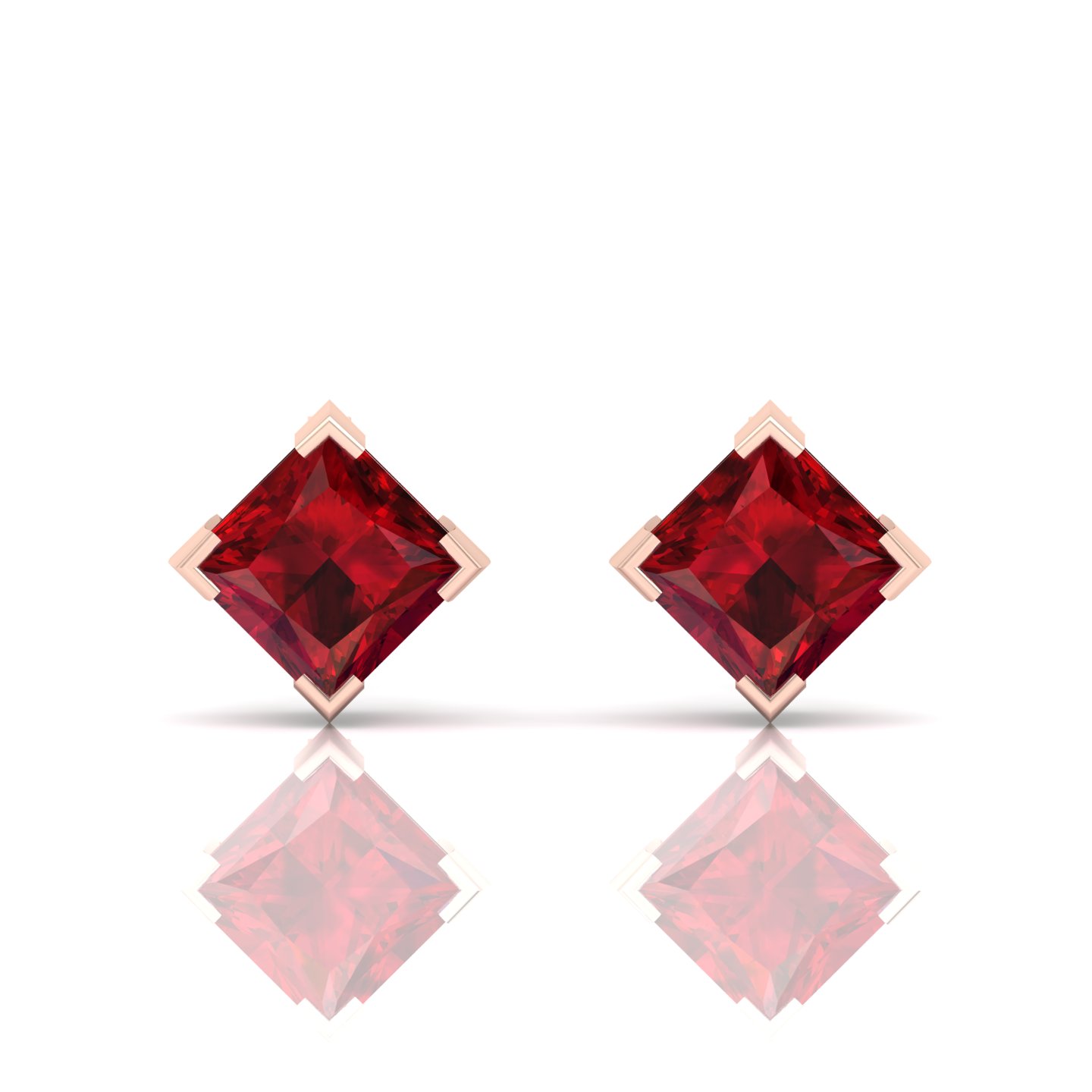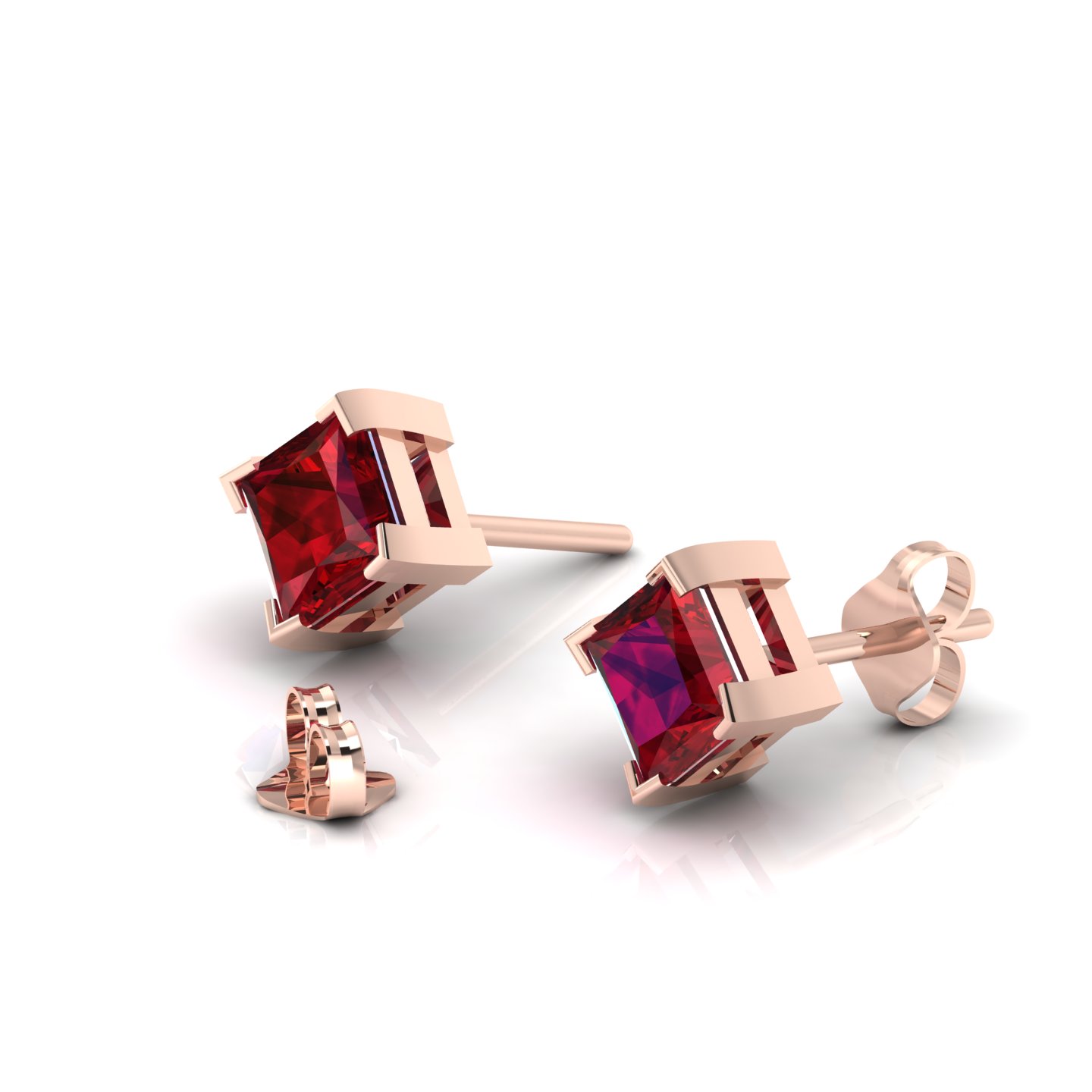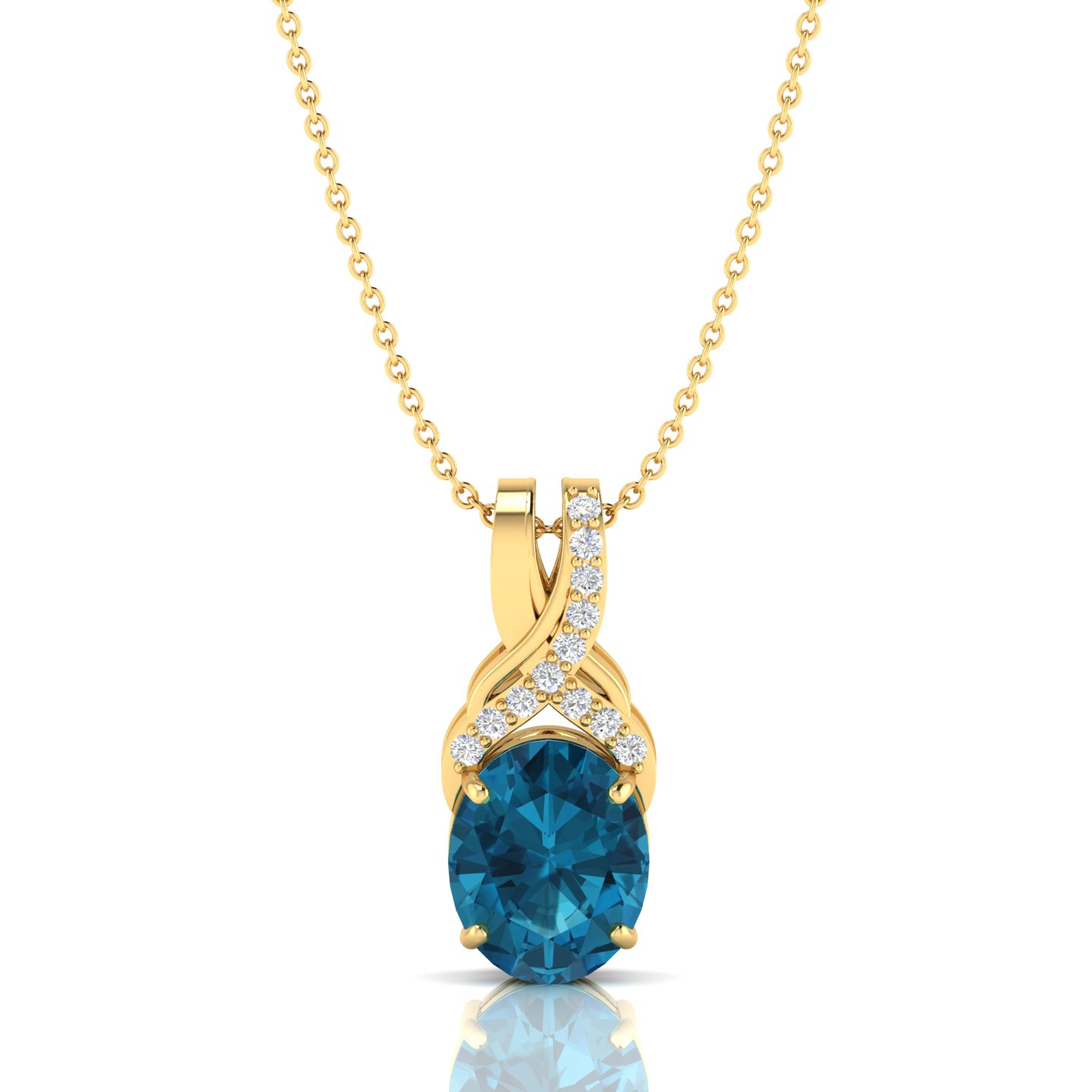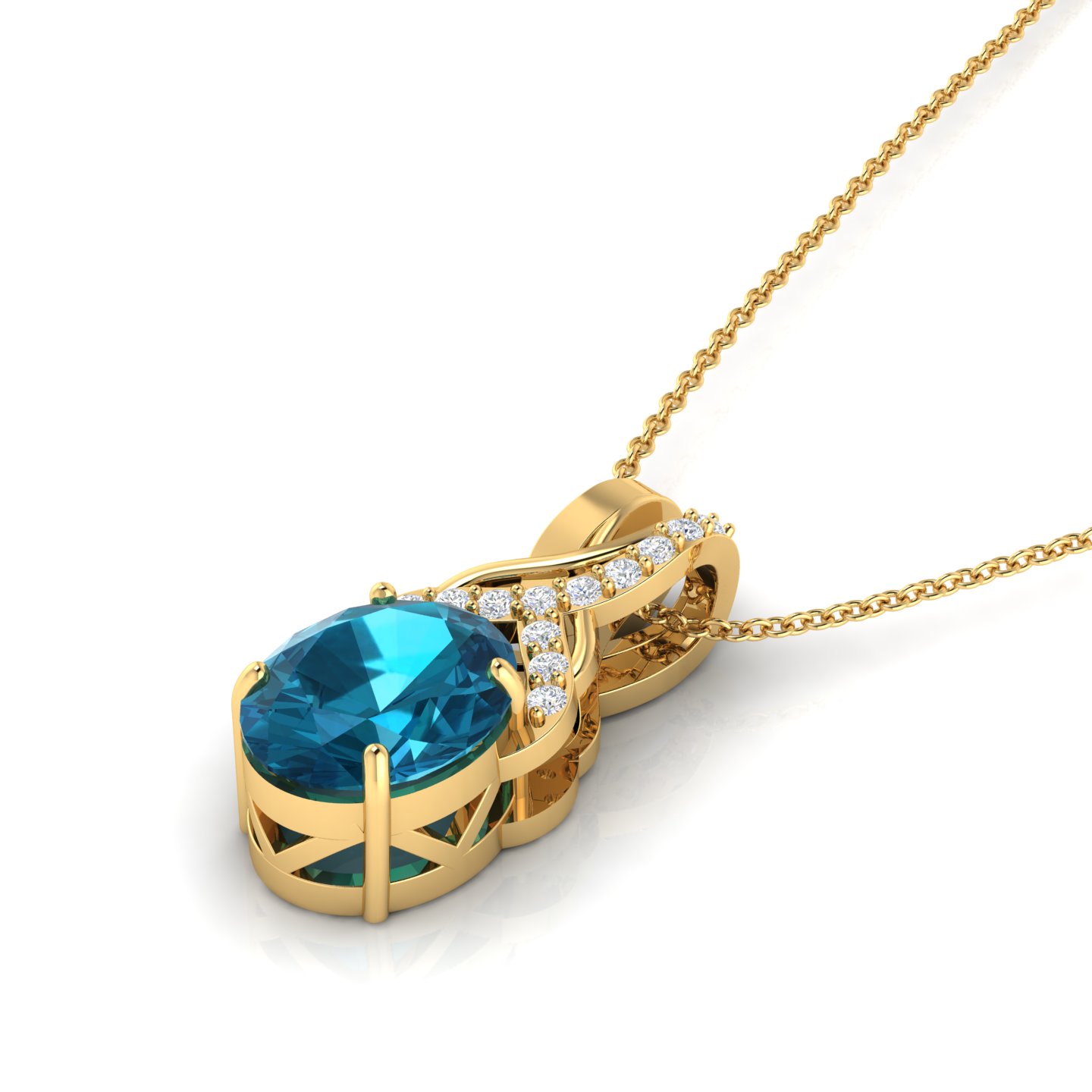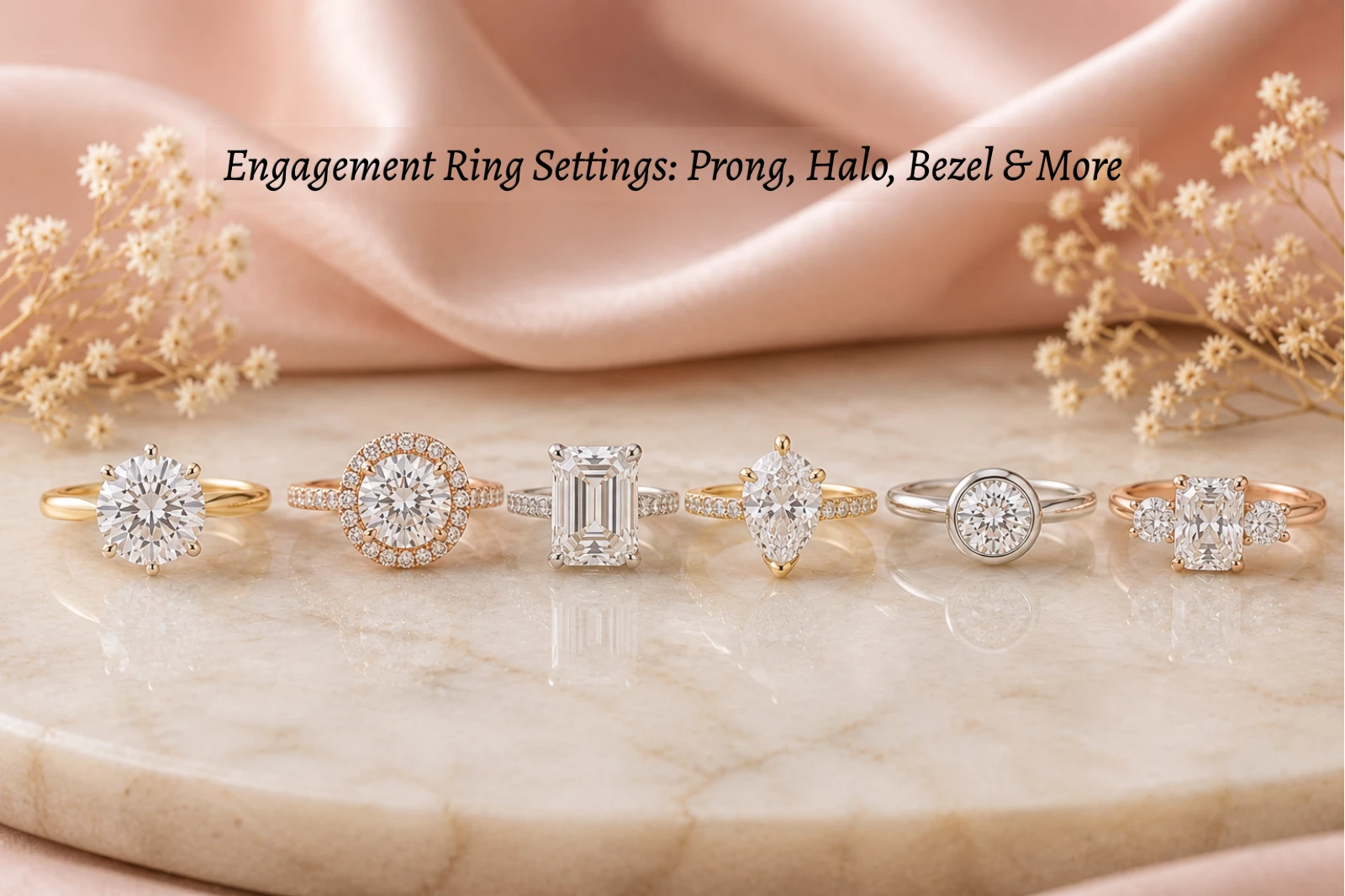
When you first look at an engagement ring, your eyes probably go straight to the center stone.
Its shape. It's sparkle. Its size.
But look a little closer.
What makes one diamond appear open and airy while another looks sleek and surrounded by metal? Why does one ring sit high above the finger while another feels almost flush against it? And why do some engagement rings sparkle across the entire band while others keep every bit of attention on a single stone?
A large part of the answer comes down to engagement ring settings.
The setting affects how your gemstone is held, how much of it is visible, how protected it feels during everyday wear, and ultimately how the entire ring looks on your hand.
From classic prongs and clean solitaires to sparkling halos, protective bezels, and modern tension designs, every setting creates a different experience.
If you're already exploring designs for your big day, you can also browse Huzurr's wedding jewelry collection while learning how each setting works.
This guide walks you through the major engagement ring settings, their advantages and drawbacks, and the factors worth considering before choosing the one that feels right for you.
What Is an Engagement Ring Setting?
An engagement ring setting is the structure or arrangement that holds and displays the gemstone or gemstones in a ring.
Think of the center stone as the star of the ring and the setting as the stage around it.
Depending on the design, the setting may use small metal prongs, a surrounding metal rim, channels, or another construction method to keep the gemstone in place.
The setting can affect:
- How much of the center stone is visible
- How high the gemstone sits above your finger
- How exposed are the edges of the stone
- How much surrounding sparkle does the ring have
- How easy the ring is to wear during everyday activities
- How much cleaning and maintenance may it require
It also helps to understand a few basic jewelry terms.
The center stone is the main diamond or gemstone.
The band, sometimes called the shank, is the part of the ring that wraps around your finger.
The metal is the material used to create the ring, such as gold or sterling silver.
The setting describes how the stone is held or presented.
Together, these elements create the finished engagement ring.
If you're still getting familiar with ring terminology, materials, styles, and designs, start with our [Complete Ring Guide: Types, Materials, Styles, Settings & How to Choose the Perfect Ring] for a broader look at how every part of a ring comes together.
Engagement Ring Settings vs. Ring Styles: What's the Difference?
"Setting" and "style" are often used almost interchangeably when people shop for engagement rings, but they do not always mean exactly the same thing.
Here is the easiest way to understand the difference.
|
Term |
What It Describes |
|
Setting |
How the gemstone is secured or presented |
|
Ring Style |
The overall visual character of the ring |
|
Ring Design |
The complete combination of stones, setting, metalwork, band, and details |
|
Center Stone |
The main gemstone or diamond |
|
Band |
The part of the ring that wraps around the finger |
|
Metal |
The material from which the ring is made |
A prong setting, for example, describes metal claws that hold a gemstone.
A solitaire, on the other hand, describes a ring that focuses on one primary center stone.
That solitaire stone may still be held by prongs.
This is why jewelry terminology can feel confusing at first. Some names describe how stones are physically secured, while others describe the overall arrangement or appearance of the ring.
You don't need to memorize every technical term before buying an engagement ring.
You simply need to understand what each design means for the way the ring looks and feels in real life.
Engagement Ring Settings Comparison
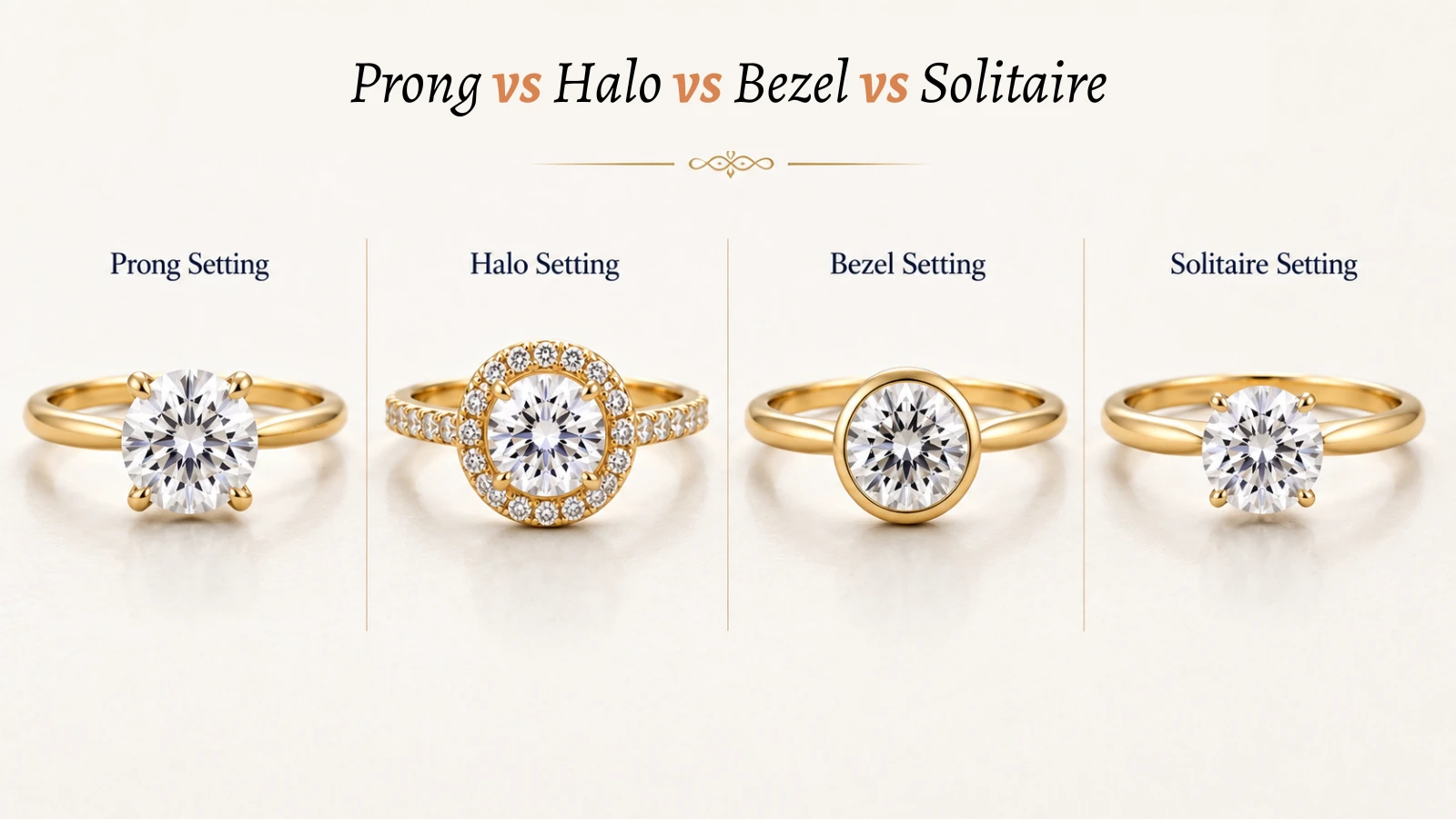 Before exploring each setting in detail, use this table as a quick showroom-style comparison.
|
Setting |
Overall Look |
Sparkle |
Protection |
Best For |
|
Prong |
Open and traditional |
Strong center-stone visibility |
More exposed edges |
Buyers who want the center stone to stand out |
|
Solitaire |
Clean and minimal |
Focuses on the main stone |
Depends on how the stone is secured |
Classic, simple tastes |
|
Halo |
Detailed and glamorous |
High surrounding sparkle |
Depends on construction |
Buyers wanting more visual presence |
|
Bezel |
Sleek and metal-framed |
More controlled appearance |
Strong edge coverage |
Active lifestyles and modern designs |
|
Pavé |
Sparkling and detailed |
High band sparkle |
Requires care around small stones |
Buyers who love extra sparkle |
|
Cathedral |
Elevated and architectural |
Strong center emphasis |
Depends on center setting |
Traditional, graceful designs |
|
Channel |
Smooth and structured |
Sparkle along the band |
Accent stones sit between metal walls |
Clean rows of accent stones |
|
Three-Stone |
Balanced and substantial |
Multiple prominent stones |
Depends on individual settings |
Symbolic or multi-stone designs |
|
Tension |
Contemporary and open |
Center stone looks highly exposed |
Specialized construction |
Modern, unconventional tastes |
|
Flush |
Low-profile and subtle |
More understated |
Stone sits within the metal |
Practical, streamlined designs |
Now let's look more closely at what each one brings to the ring.
Types of Engagement Ring Settings
There is no single engagement ring setting that works for everyone.
Some people want as much of the diamond visible as possible. Others care more about protection during everyday wear. Some want a clean band with one center stone, while others want sparkle everywhere they look.
Understanding the major setting types makes those decisions much easier.
Prong Setting
A prong setting is one of the most recognizable ways to hold a center gemstone.
Small metal claws rise from the ring and grip the gemstone at carefully selected points.
Because relatively little metal covers the stone, much of the gemstone remains visible.
That open appearance is one reason prong settings are so popular in engagement rings.
Common designs may use four or six prongs.
A four-prong arrangement leaves more of the stone visually open, while a six-prong arrangement uses additional points of contact around the gemstone. The best option depends on the ring design, gemstone shape, proportions, and construction.
What Does a Prong Setting Look Like?
Prong-set stones often appear elevated and prominent.
From the side, you can usually see more of the gemstone than you would in a full bezel setting.
To see this construction on an actual Huzurr piece, look at this princess-cut blue sapphire V-prong solitaire ring. Its product specifications identify the setting as V-prong, making it a useful real-world example of how prongs can support a shaped center stone.
Advantages of a Prong Setting
- Keeps the center gemstone highly visible
- Creates a classic engagement-ring appearance
- Works with many gemstone shapes
- Keeps visual attention focused on the center stone
- Can create a light, open look
Potential Drawbacks
Because more of the gemstone remains exposed, its edges may come into greater contact with clothing, objects, or everyday surfaces.
Prongs themselves should also be checked periodically. Over time, fine jewelry can experience normal wear, and a professional inspection can help identify prongs that may need attention.
Who Is It Best For?
A prong setting is worth considering if you love a traditional engagement-ring appearance and want your center stone to remain the main attraction.
Solitaire Setting
A solitaire ring centers the design around one primary gemstone.
Simple? Yes.
Boring? Not necessarily.
The beauty of a solitaire is that nothing competes with the center stone.
There may be no halo, no rows of accent diamonds, and no group of side stones demanding attention.
Instead, your eye goes directly to the gemstone.
Solitaire designs can feel elegant, clean, modern, traditional, or even dramatic depending on the center stone, metal, band proportions, and how the gemstone is secured.
It is important to remember that "solitaire" does not describe one specific holding mechanism.
A solitaire diamond might still be secured with prongs or another suitable setting method.
If this clean, center-stone-focused look appeals to you, Huzurr has a dedicated collection of wedding diamond solitaire rings to compare with more detailed designs.
Benefits of a Solitaire
- Keeps attention on the center stone
- Creates a timeless, uncluttered look
- Can work with many gemstone shapes
- Often pairs easily with different wedding-band styles depending on the ring's construction
Limitations
If your dream ring involves lots of sparkle across the band or stones surrounding the center, a traditional solitaire may feel too minimal.
Protection also depends on the actual center-stone setting used.
Who Should Consider It?
Someone who keeps returning to simple designs every time they browse a jewelry collection.
If your instinct is, "I just want a beautiful stone and a beautiful band," solitaire may be exactly where you should start.
Halo Setting
A halo setting surrounds the center gemstone with smaller accent stones.
The result is an immediate visual impact.
Instead of seeing one gemstone alone, your eye sees a sparkling frame around it.
A traditional halo is normally visible when you look at the ring from above.
Some rings also use a hidden halo, where accent stones sit lower around the center setting and are more noticeable from the side than from the top.
Why People Love Halo Settings
A halo adds extra sparkle around the center without requiring several large feature stones.
It can also create a more detailed, glamorous appearance.
One useful Huzurr example is this radiant-cut citrine and diamond ring, whose product description combines a prong-held center with pavé-style accent stones and a halo effect around the focal stone.
Advantages
- Adds surrounding sparkle
- Frames the center gemstone
- Creates a strong visual focal point
- Works with many center-stone shapes
- Can make the center area of the ring feel more substantial
Potential Drawbacks
More accent stones also mean more small areas to clean and inspect.
A halo has more components than a plain solitaire, so someone who prefers extremely simple jewelry may find it too detailed.
Best Suited For
Someone who wants people to notice the ring from across the table.
If your jewelry taste leans toward sparkle, detail, and visual presence, Halo deserves a place on your shortlist.
Bezel Setting
If prongs leave a gemstone open, a bezel takes almost the opposite approach.
In a bezel setting, metal surrounds all or part of the gemstone's perimeter to help hold it securely in place.
The result is smooth, defined, and often very modern.
A bezel can create a clean outline around the gemstone and reduce the amount of exposed edge compared with many open prong designs.
Why Bezel Settings Are Practical
The surrounding metal offers added coverage around the edge of the stone.
For someone who works frequently with their hands or simply dislikes highly exposed settings, that can be an appealing feature.
Advantages
- More metal surrounds the gemstone
- Smooth visual outline
- Less exposed perimeter than many prong settings
- Often works well with streamlined, contemporary designs
- Can suit buyers who prioritize everyday practicality
Potential Drawbacks
A bezel changes the visual character of the gemstone.
Because more metal surrounds it, the appearance is less open than a prong setting.
That is not necessarily better or worse. It simply creates a different look.
Who Should Consider a Bezel?
Someone who wants a sleek engagement ring and feels more comfortable with additional metal around the gemstone.
It is especially worth comparing if you prefer lower-profile jewelry or live an active day-to-day lifestyle.
Pavé Setting
If you want sparkle to continue beyond the center stone, pavé is where things become interesting.
In a pavé design, small accent stones are set closely together along part of the ring, commonly the band.
Instead of seeing a continuous surface of plain metal, you see a line or field of tiny sparkling stones.
What Makes Pavé Different?
The sparkle is distributed across the band rather than concentrated entirely around the center stone.
A pavé band can be paired with a solitaire, halo, or other center-stone design.
Advantages
- Adds noticeable sparkle to the band
- Makes the entire ring feel more detailed
- Complements a prominent center gemstone
- Works with many overall ring styles
Potential Drawbacks
Small accent stones and their setting points require care.
Cleaning may take more attention than with a completely plain band, and periodic inspection is sensible for rings containing many smaller stones.
Best Suited For
Someone who looks at a plain band and immediately thinks, "I want a little more sparkle."
Or a lot more.
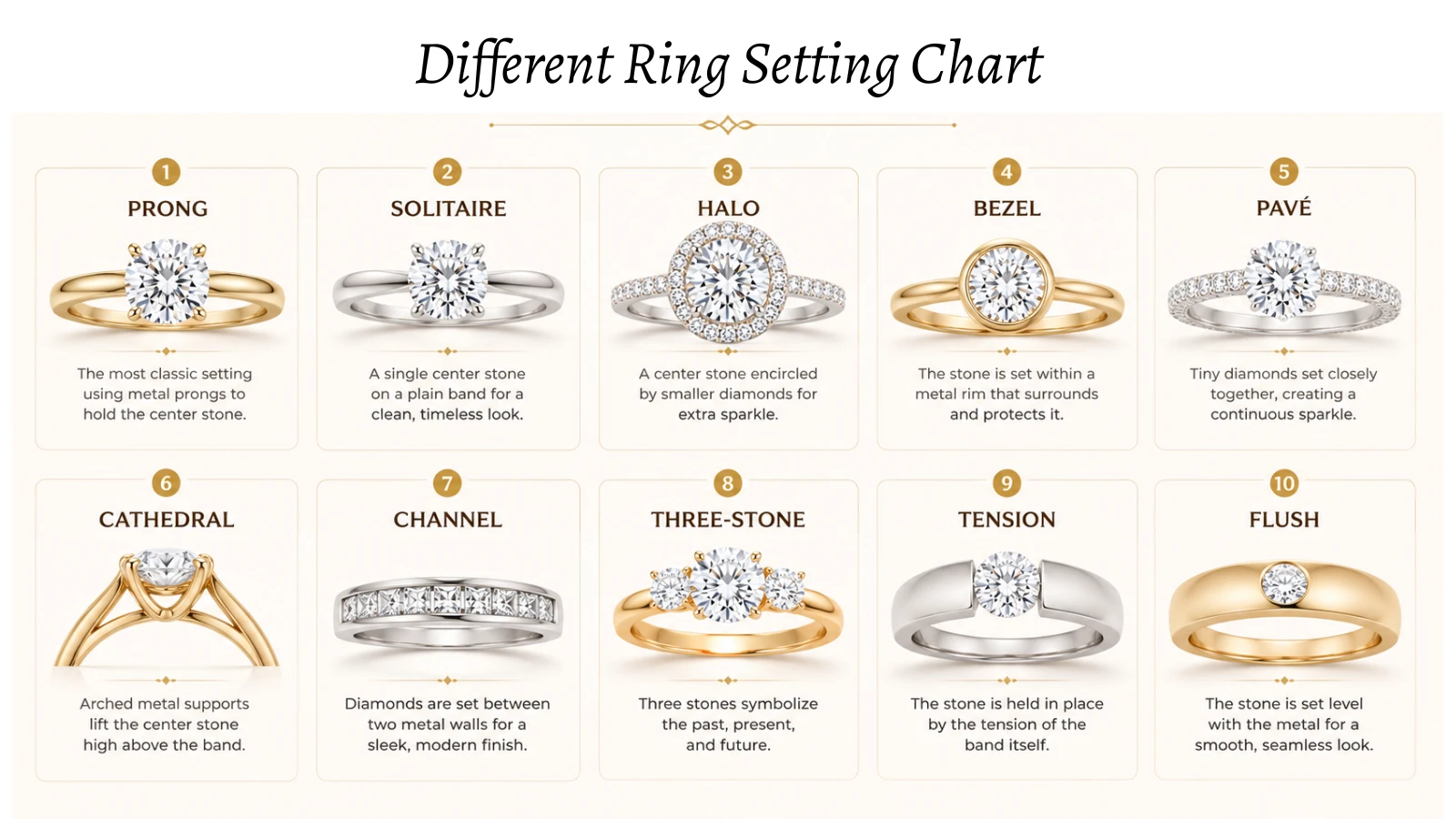 Cathedral Setting
A cathedral setting gets its name from its graceful architecture.
The band rises toward the center gemstone in arches, creating a structure reminiscent of the sweeping supports found in cathedral architecture.
The center stone usually appears elevated and visually framed by the rising sides of the ring.
Visual Character
Cathedral rings often feel:
- Traditional
- Elegant
- Architectural
- Elevated
- Romantic
The structure itself can become part of the beauty of the ring rather than simply disappearing beneath the gemstone.
Advantages
- Gives the center stone a strong visual presence
- Adds decorative metalwork
- Creates a graceful side profile
- Can feel substantial without relying entirely on accent stones
Potential Drawbacks
Higher settings may not be ideal for everyone.
If you regularly wear gloves, work with your hands, or simply prefer jewelry sitting closer to the finger, look carefully at the side profile before choosing.
Best Suited For
Someone who wants their engagement ring to feel traditional and elegant, with a center stone that visibly rises above the band.
Channel Setting
Channel settings are commonly used for accent stones along the band.
The stones sit side by side between two walls or strips of metal.
Rather than each small stone appearing individually exposed, they form a neat, continuous row.
Channel vs. Pavé
This is an easy difference to remember.
In a channel setting, stones sit within a defined metal channel.
In a pavé setting, small stones are set closely across the surface of the band using tiny setting components.
Visually, channel-set stones often feel more structured and geometric.
Advantages
- Clean rows of accent stones
- Smooth visual appearance
- Defined metal edges
- Accent sparkle without the same surface texture as some pavé designs
Potential Drawbacks
Like other designs using multiple stones, channel settings require cleaning around the accent stones.
Repairing or resizing certain channel-set rings can also be more complex depending on the exact construction.
Best Suited For
Someone who loves accent stones but prefers an organized, streamlined look rather than a more delicate pavé texture.
Three-Stone Setting
Three-stone engagement rings place one center gemstone between two prominent side stones.
Instead of one visual focal point, the ring creates a wider composition across the finger.
The center stone normally remains the main feature, while the side stones provide balance and additional presence.
Three-stone rings are also commonly associated with the idea of past, present, and future, although you don't need to attach that meaning to the design if it doesn't resonate with you.
Advantages
- Creates a broader visual focal point
- Gives you multiple prominent gemstones
- Allows different stone shapes to work together
- Can carry sentimental symbolism
Potential Drawbacks
Multiple feature stones mean multiple settings to clean and inspect.
The proportions of the side stones also matter. If they visually overpower the center stone, the composition can feel unbalanced.
Best Suited For
Someone who wants more than one important stone in the ring or likes the emotional symbolism often associated with three-stone designs.
Tension Setting
A tension setting has one of the most distinctive appearances in engagement-ring design.
The gemstone appears to be suspended between two sides of the ring.
Instead of obvious prongs surrounding it, carefully engineered pressure helps hold the gemstone in position.
The visual effect can be strikingly modern.
Advantages
- Highly contemporary appearance
- Minimal visible hardware around the gemstone
- Creates an open, almost floating visual effect
Limitations
Tension settings require specialized construction.
Depending on the ring, resizing, repairs, or adjustments may be more complex than with more conventional designs.
Who May Prefer It?
Someone who finds traditional engagement rings too predictable and wants a design that feels architectural, minimal, and unconventional.
Flush Setting
A flush-set gemstone sits within the surrounding metal rather than rising dramatically above it.
The upper surface of the gemstone sits close to the surface of the ring, creating a low-profile appearance.
This style can feel particularly clean and understated.
Advantages
- Reduced protrusion
- Streamlined appearance
- More surrounding metal coverage
- Practical for people who dislike elevated stones
Potential Drawbacks
Because less of the gemstone is prominently exposed, a flush setting usually creates a subtler visual effect than a raised prong or halo design.
Best Suited For
Someone who values comfort, minimalism, and a low-profile ring more than maximum visual drama.
How to Choose the Right Engagement Ring Setting
You have now seen ten different options.
So which one should you actually choose?
There is no universally "best" engagement ring setting.
The right setting is the one that balances your lifestyle, center stone, personal taste, maintenance expectations, and budget.
For couples who want a design that doesn't already exist in a standard collection, Huzurr also offers custom jewelry design, where customers can choose design ideas, gemstones, metals, and other details before the piece is manufactured.
For the setting specifically, start with these six questions.
Consider Your Lifestyle
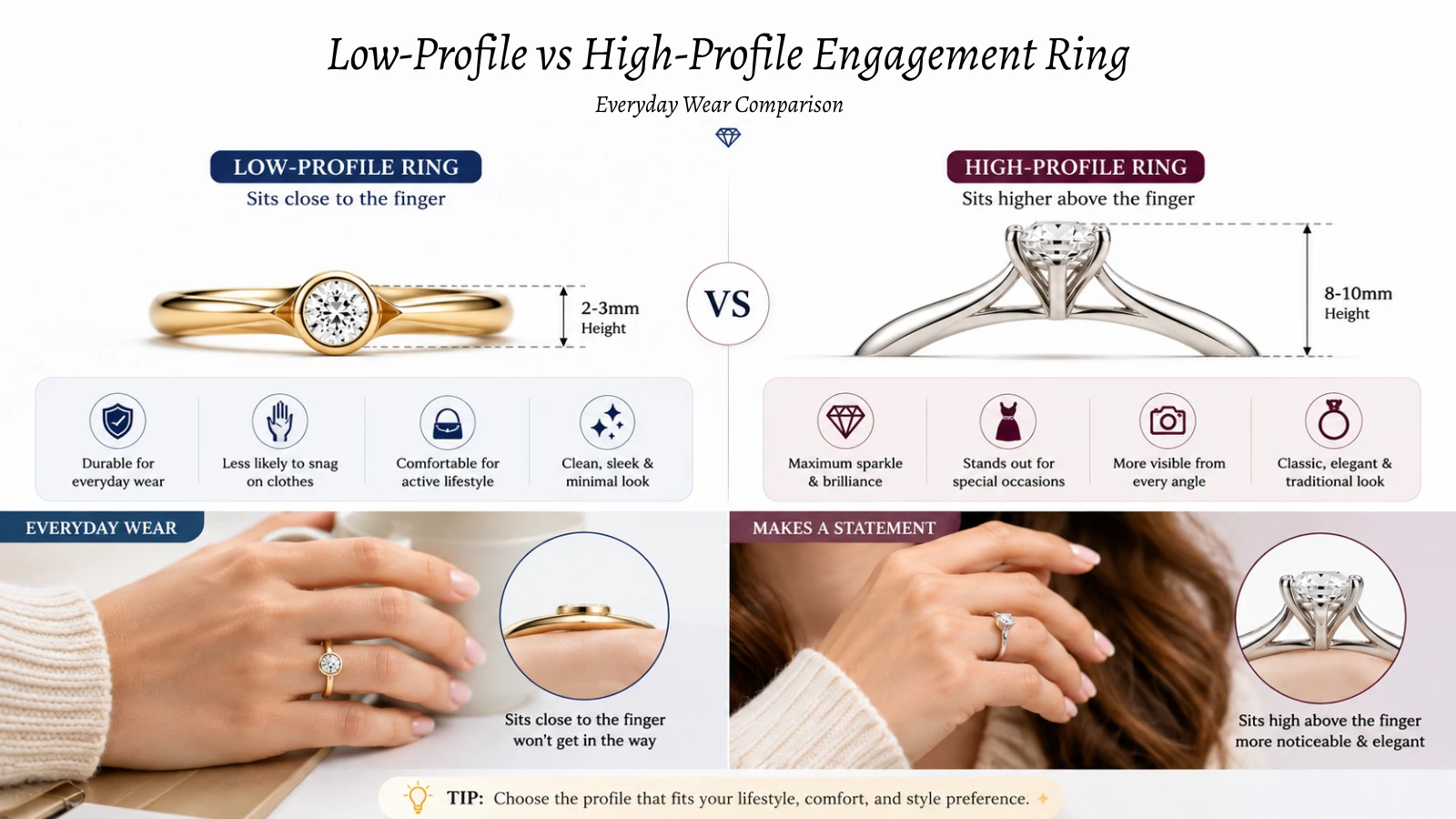 An engagement ring may be romantic, but it still has to live in the real world.
Think about what your average Tuesday looks like, not only how the ring will look in engagement photos.
Do you work with your hands?
Wear gloves regularly?
Exercise frequently?
Spend a lot of time cooking, gardening, crafting, or handling equipment?
Or is your day-to-day lifestyle relatively gentle on jewelry?
Someone with an active lifestyle may prefer to compare lower-profile designs such as certain bezel or flush settings.
Someone who loves a highly elevated center stone may still choose one, but they should understand how it interacts with their routine.
There is no maintenance-free fine-jewelry setting.
The goal is to choose one whose maintenance and profile feel realistic for your life.
Consider Your Diamond Shape
The shape of your center stone can influence how different settings look and function.
Round, oval, cushion, emerald, pear, marquise, and princess-cut stones all have different outlines.
Those outlines affect:
- Where a stone can be supported
- How a halo follows its shape
- How side stones can be arranged
- How wide or elongated the finished ring appears
- How exposed certain points or corners may be
For example, a halo can closely follow the shape of a center stone, while a three-stone design needs side stones that visually balance the center.
Do not choose a setting based only on a rule like "this setting is best for this diamond shape."
Look at the actual finished ring.
The relationship between stone and setting matters more than a generic category label.
Consider How Much Sparkle You Want
Imagine five rings sitting together in a jewelry case.
One has a center stone held openly by prongs.
One is a simple solitaire.
One has a sparkling halo.
One has pavé running down the band.
One is surrounded by smooth bezel metal.
They may all contain beautiful gemstones, but visually they feel completely different.
If you want the center stone to dominate, consider a prong-set or solitaire-focused design.
If you want more sparkle surrounding the center, compare halo rings.
If you want sparkle continuing across the band, pavé may appeal to you.
If you prefer smooth metal framing the gemstone, bezel offers another direction.
Remember that additional sparkle often comes from additional accent stones.
Sometimes the question is not:
"Which setting sparkles most?"
It is:
"Where do I want the sparkle to appear?"
Consider Protection and Security
Every engagement ring is designed to hold its stones securely, but different designs leave different amounts of the gemstone exposed.
A prong setting usually keeps much of the stone open and visible.
A bezel surrounds more of the perimeter with metal.
A flush setting places the stone deeper within the ring.
Each approach creates a trade-off between visual openness, profile, and coverage.
The exact craftsmanship of the ring also matters.
Even a secure setting should be periodically inspected, especially if the ring is worn daily.
No engagement ring is immune to impact or normal wear.
So instead of searching for an "indestructible" setting, choose a design that offers a level of coverage and maintenance you are comfortable with.
Consider Your Personal Style
This is the enjoyable part.
Forget technical terminology for a moment and think about what you naturally wear.
If your wardrobe and jewelry are simple and timeless, you may gravitate toward:
- Solitaire
- Traditional prong
- Cathedral
If you love clean contemporary design:
- Bezel
- Tension
- Flush
May feel more natural.
For someone drawn to romantic or glamorous jewelry:
- Halo
- Pavé
- Three-stone
can create more visual detail.
Vintage-inspired rings may incorporate halos, decorative metalwork, pavé, milgrain, or other ornamental details.
There is no need to choose the setting people say is trending.
Your engagement ring may be on your hand long after today's trend cycle disappears.
Choose what still feels like you when the excitement of shopping has settled down.
Consider Your Budget and Maintenance
The center stone is only one factor affecting the final price of an engagement ring.
The setting itself can also influence cost.
Factors may include:
- Number of accent stones
- Quality and size of those stones
- Amount and type of metal
- Complexity of the design
- Labor and craftsmanship
- Customization
- Decorative details
A simple solitaire and a pavé halo design can require very different amounts of material and workmanship.
Maintenance matters too.
Ask yourself whether you are comfortable with:
- Cleaning around multiple stones
- Having prongs inspected
- Checking accent stones periodically
- Handling potentially more complex repairs
- Maintaining intricate metalwork
If you're considering a personalized setting, Huzurr's customized jewelry process also shows how design ideas are translated into a 3D model before manufacturing, which can be helpful when you're deciding on stone placement, metal, and overall structure.
Do not think only about what the ring costs on purchase day.
Think about how you want to live with it over the years.
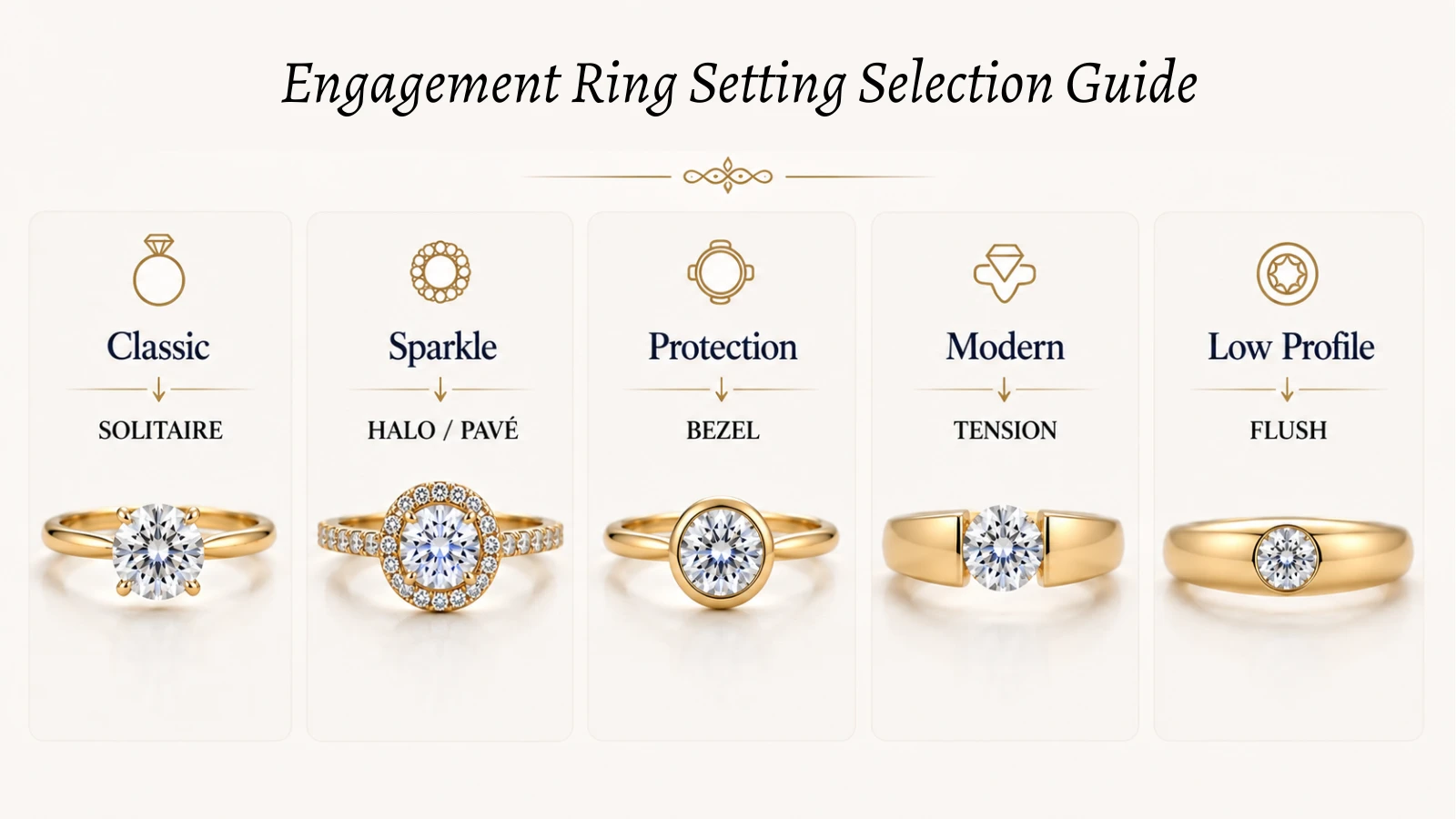 Which Engagement Ring Setting Is Best for You?
Still narrowing things down?
Use this quick decision guide.
|
If You Want... |
Consider... |
Why |
|
Maximum center-stone visibility |
Prong |
Less metal covers the visible gemstone |
|
Classic, simple look |
Solitaire |
Attention stays on one primary stone |
|
More surrounding sparkle |
Halo |
Accent stones frame the center |
|
Sparkle across the band |
Pavé |
Small stones add shine along the ring |
|
More stone-edge coverage |
Bezel |
Metal surrounds much or all of the perimeter |
|
Low-profile appearance |
Flush or certain bezel designs |
Less of the gemstone projects above the ring |
|
Multiple prominent stones |
Three-stone |
Center and side stones create a wider focal point |
|
Traditional elevated look |
Cathedral |
Arched shoulders visually raise the center |
|
Clean accent-stone rows |
Channel |
Stones sit neatly between metal walls |
|
Modern, unconventional look |
Tension |
Creates an open, suspended appearance |
One final tip: don't choose from the setting name alone.
Two rings described as "prong settings" can have very different heights, bands, prong shapes, and proportions.
Whenever possible, look at the ring from the top, the side, and on the hand before making your final decision.
Frequently Asked Questions
What Is the Most Popular Engagement Ring Setting?
Popularity can vary by year, personal taste, and jewelry trends. Prong and solitaire-focused designs remain familiar choices because they keep strong attention on the center stone, while halo, pavé, bezel, and other settings appeal to buyers looking for different combinations of sparkle, protection, and style.
What Is the Difference Between a Prong Setting and a Solitaire?
A prong describes a method of securing a gemstone using small metal claws. Solitaire describes a ring design focused on one primary center stone.
A solitaire ring can therefore use prongs to hold its gemstone.
You can see this relationship clearly when browsing Huzurr's diamond solitaire ring collection alongside individual products that specify prong settings.
Is a Bezel Setting Good for Everyday Wear?
A bezel can be appealing for everyday wear because metal surrounds more of the gemstone's perimeter than in many open prong designs.
However, any fine jewelry ring still requires sensible wear, cleaning, and periodic inspection.
Which Engagement Ring Setting Gives the Most Sparkle?
There is no single answer because sparkle depends on the gemstones and the complete ring design.
Halo settings add stones around the center, while pavé designs add accent stones along the band.
A ring combining multiple accent-stone techniques may create even more overall sparkle.
Which Setting Offers More Protection for a Center Stone?
Settings that provide more metal coverage, such as bezel or flush designs, generally leave less of the gemstone edge exposed than open prong settings.
That does not mean the gemstone becomes damage-proof, and exact protection depends on the individual ring's construction.
Are High-Set Engagement Rings Harder to Wear?
They can require more awareness during daily activities because more of the ring projects above the finger.
Some people love the elevated appearance, while others prefer a lower-profile setting because it better suits their routine.
Do Engagement Ring Settings Need Maintenance?
Yes.
Fine jewelry benefits from regular cleaning and inspection. Prongs, accent stones, channels, and other setting components can experience normal wear over time.
Maintenance needs vary depending on the design.
Final Thoughts: Your Setting Should Fit More Than Your Stone
A beautiful engagement ring is not simply a beautiful center stone placed on a band.
The setting shapes the way that stone is presented every day.
Prongs can create an open, traditional look.
Solitaire designs keep things beautifully simple.
Halos and pavé add layers of sparkle.
Bezels and flush settings offer smoother, more metal-surrounded profiles.
Cathedral settings bring height and architecture.
Three-stone designs expand the focal point.
Channel and tension settings each create their own distinctive character.
The right choice depends on what matters most to you.
Think about your lifestyle.
Look at your center-stone shape.
Decide where you want the sparkle.
Consider how much gemstone coverage you prefer.
Be realistic about maintenance.
And most importantly, choose a ring that still feels like your ring, not simply the setting everyone else is currently buying.
Once you have narrowed your preferences to two or three engagement ring settings, start comparing actual finished designs from different angles.
You can browse Huzurr's wedding jewelry collection for ready-made inspiration, explore diamond solitaire rings if you prefer a classic center-stone-focused look, or use Huzurr's custom jewelry service if you want the setting, stone, metal, and details built around your own idea.
The goal isn't simply to find the most impressive setting.
It's to find the one you'll still love seeing on your hand years from now.